One Page: The Batman Bunch

Tags

, , , , ,

img_2503

David Finch, Tom King, Mitch Gerads and Danny Miki, Batman vol. 3, I Am Bane (via Hoopla).
I like Finch’s character work on this page. The three young men in the second panel are Batman’s progeny – two surrogate sons (his oldest and the prodigal one) and his only biological son (the youngest). Finch conveys who they are and their relationship with each other through facial expressions and body language.
  • Dick (Nightwing) is the one sitting alone in the booth, the one who is relaxed and comfortable in his own skin. The one who comes closest to being a well adjusted person.
  • Jason (Red Hood) is the angry one, the rebel without a cause. He communicates through sarcasm and provocations.
  • Damian (Robin) is the young one, one who pretends to be an entitled jerk but doesn’t want you to know that he’s just an adolescent boy.
  • Bruce (you know who…) is the father figure and a man who is not comfortable in a fast food restaurant.

The dialogue sharpens the distinctions between the men (and boy), but you’d get it without reading a thing.

The four are meeting in a “Batman” themed fast food restaurant, which gives Finch the opportunity to add humorous elements in the background that lighten the tone of the story. There’s something extremely ironic about the panel in which the three proteges banter in front of a Joker themed wall decoration.

This was a fun read. I find that I appreciate superhero comics more when I read them the same way I did when I was a kid/adolescent – with enthusiasm and a sense of generosity.

I had a mixed response to the parts of the story focused on the conflict between Bane and Batman. I was intrigued by the broad strokes of the story, in which Batman is trying to defeat a foe who was not only stronger than him, but had successfully broken the body and mystique of Batman in the past. In the first two volumes, King and Finch explored the nature of the character through stories exploring his role as a mentor to other heroes (who were not sidekick/surrogate child figures), a tactician and leader of a group of amoral adventurers and as a failed/tragic romantic figure in his relationship with Catwoman. In this volume, Finch and King use a physical conflict between Batman and a superior foe to help the reader understand a man who would dress up as a bat to fight crime. There’s a long buildup to the battle in this volume. We see Batman prepare for war and Bane dispatch all of the other members of the cast (hero and villain alike) with ease.

The conflict between the two takes up most of an issue and feels pretty anti climatic on the first read. Finch and King mix sequences of Bane beating Batman senseless (while the two verbally spar) with an imagined monologue delivered by a figure from Batman’s past that helpfully summarizes the plot and transforms the subtext into text. Finch alternates between panels illustrating the combat and ones which complement the monologue (e.g., a panel featuring Catwoman accompanying a passage about doomed love). The fight ends as one might expect (hint: we’re not reading the continued adventures of ‘Bane‘). It was a bit anti-climactic – I wanted a perfectly choreographed martial arts inspired battle between two skilled combatants, but I got a brawl with a pretty implausible conclusion.

On a second read (with more sleep), I had a better sense of things. The story inverts Knightfall, the classic Batman story by an army of creators including Denny O’Neil, Chuck Dixon, Jim Aparo and Norm Breyfogle that introduced Bane a quarter century ago. In Knightfall, Bane defeats Batman by pitting him against a gauntlet of his most dangerous foes (he stages a breakout at Arkham Asylum, the residential facility/hostel for Batman villains) and viciously attacking him when he is at his weakest. Finch and King have Batman borrow Bane’s old technique by using the tools at his disposal (including his enemies) to drive Bane to mental exhaustion and use a ‘rope a dope’ strategy (which involves letting Bane pummel him into oblivion) to further exhaust and distract him.

Although the experience of reading the scene is still a tad unsatisfying – I would have preferred more visual cues hinting at the strategic planning behind the physical conflict – the final moment of the battle does feel more powerful.

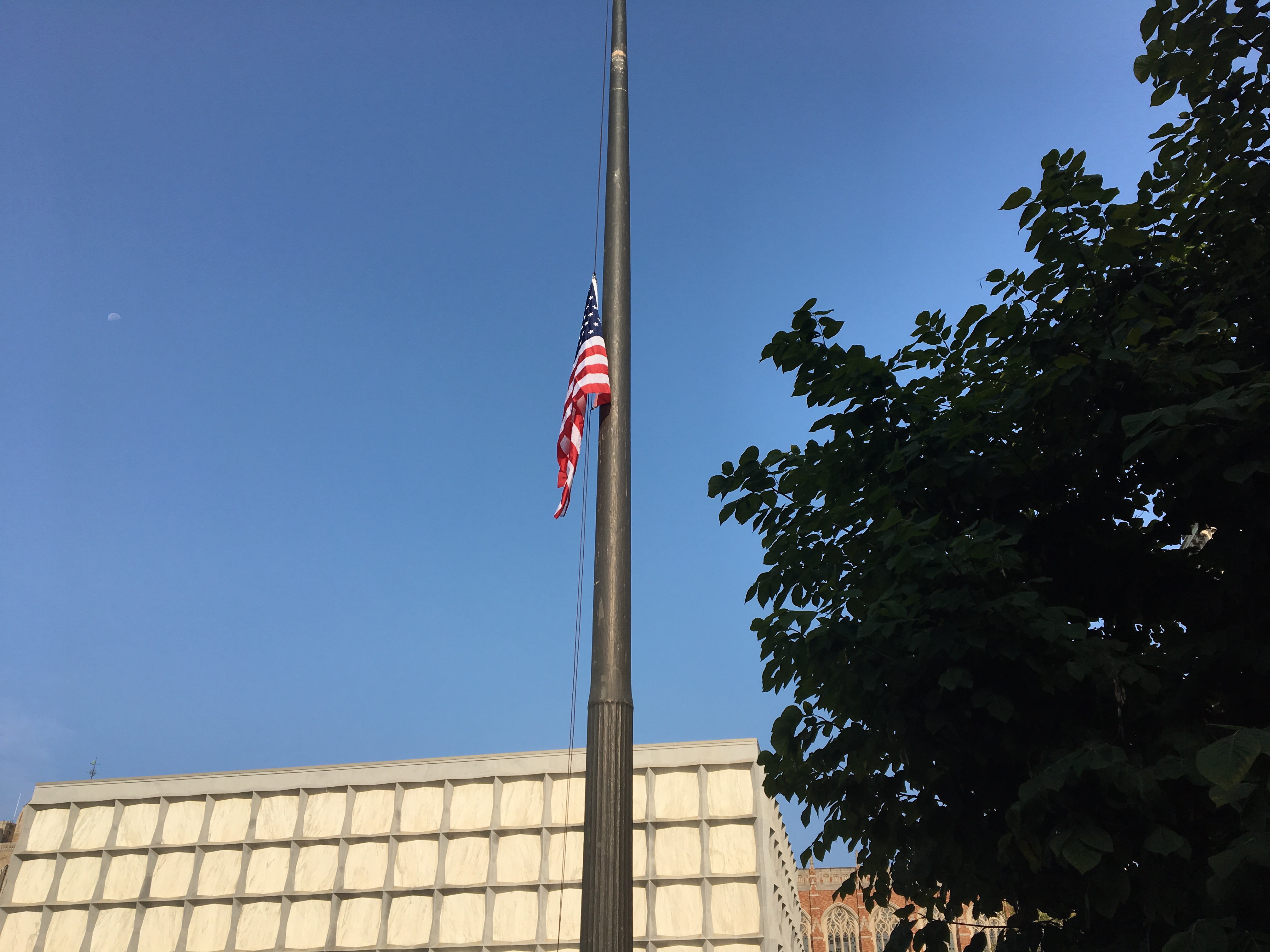
Time Precious, I Ain’t Had Rest Since 9/11

Tags

Sixteen years. It still feels like the towers went down a short while ago, but a glance at the crowd at Beinecke Plaza in New Haven for Yale’s 9/11 remembrance ceremony reminded me that for some, sixteen years is a lifetime. Some of the young people who surrounded me were Yale undergraduates who were toddlers when the towers fell. For others, the tragedy may have been their first memory of a public tragedy (mine was the Challenger space shuttle disaster from 1986). I imagine that some of the students grew up thinking of 9/11 as a tragedy that took place in a foreign land. There were also plenty of folk from my generation in the crowd, along with those who remembered wars and tragedies from before my time.

We listened to a man who graduated from Yale College the year after I graduated from SUNY Purchase talk about 9/11 and the sensation of being swallowed whole. He prompted us to reflect on the sixteen years after 9/11, to ask ourselves: “what kind of person have you become?” “what neighbor have you helped?”

I’m tempted to write about how I’ve changed in the last sixteen years, to think about how my life is different than I expected (in good ways and bad), or about how that sense of terror and panic that followed the fall of the towers never went away. I could tie my personal and professional narrative to a commitment to helping people from marginalized groups. It might even be true.

But that’s not what I think about when I reflect on 9/11. I think about the people whose stories came to an abrupt end, those who didn’t have the opportunity to finish crafting their narrative. The people who never experienced all of the amazing and terrifying things that happened over the last sixteen years.

I think about them – all strangers to me – and the sixteen years fall away, and I’m listening to my grandmother tell me on the phone that a plane hit one of the towers of the World Trade Center, and I turn the tv on to the Today show and try to reassure her (“it’s probably just a terrible accident”, “a horrible coincidence”) and watch the second plane hit the tower.

Yale Chaplain Sharon Kugler spoke at the outset of the event, and a phrase she delivered stuck in my mind. “Let us embody peace.” I can try. It feels like the best way of honoring those whose stories came to an end sixteen years ago.

New Haven Road Race 2015-17

Tags

img_0777

One of the first things I did when I moved to New Haven in the fall of 2014 was to sign up for races. I enjoy running, but due to time constraints, I usually do so in the early morning on nearly empty roads. Races are an opportunity to run with enthusiasts of all genders, ages and sizes. They are also a great way of learning the geography of a new town.

This is my third year running the New Haven Road Race. The first time I ran, I was following the crowd and hoping that I wouldn’t get lost. By the second, not only did I know where I was going, I knew the best place to get a post-run breakfast (the Pantry on Mechanic Street). Today, I ran through my neighborhood.

I’ve also become a better runner, which is pretty gratifying. I’ve made some real improvements to my time over the last three years (and have run progressively longer distances when running alone).

Faxon Law New Haven Road Race 
Year Overall Overall w/in age group (30-39) Time  Time (net) Time per mile 
2015 292/3062 29/179 22:00 22:29 7:15
2016 256/2655 26/154 21:33 21:55 7:04
2017 156/2736 15/150 21:00 20:42 6:46

Next Year: 20K!

August 2017 Runs 

This slideshow requires JavaScript.

Skull & Bones 1

Tags

, , , , , , , , , , , , , , , , , , , , , , , , , , , , , , , , ,

I was confronted by two Red Skulls the other day while I was browsing the Comixology digital storefront (looking for a good bedtime read). The covers from Joe Casey and Nick Dragotta’s Vengeance and Greg Pak and Mirko Colak’s Red Skull: Incarnate miniseries stared at me from the row of comics in my collection.

The Red Skull has been dead in Marvel for a long time now. Sure, he’s been resurrected a couple of times since then –  in the bodies of a clone of Steve Rogers (the original Captain America), a Russian post-cold war billionaire, and a clone with a piece of Charles Xavier’s brain – but it just doesn’t feel the same.

These were diluted Skulls. The images staring at me from the screen were the real thing.

Continue reading

Moving Pictures that Move Me (Part One of ?)

Tags

, , , , , , ,

I care about complete artistic statements in pop culture – the album, the film, the run on a comic book series by a single creative team, or the complete television series. When I wax nostalgic about a youth misspent listening to music, I dream of the seemingly endless series of near-perfect hip-hop albums from my high school years.*

I enjoy scenes from films and passages from books, but always felt like their meaning mostly came from their relationship with the larger whole. The scenes and passages that tend to linger over the years are the ones that are informed by (or inform) other scenes in the larger work.

But there are still some moments that I can enjoy as discrete statements of their own. Here are  a few from film and television:

Ocean’s Twelve, directed by Steven Soderbergh

Treme, Season 3, Ep. 2, directed by Jim McKay

Mad Men, Season 5, Episode 12, directed by Chris Manley

The Raid: Redemption, directed by Gareth Evans

More later.

*Note: I am not being an old fogey, I grant that every generation of high schoolers has an identical experience with the great albums of their time.

Modernism and Surrealism on a Sunny Day

Tags

, , , , , , , , , , ,

Highlights from a visit to the Yale Art Gallery on a lazy Saturday afternoon.

I loved everything, but the surreal Tu m’ and La boite de pandore resonated in my imagination. Rene Magritte’s La boite de pandore (Pandora’s Box) feels like the beginning of a beautiful nightmare, a mystery that can never be solved. Marcel Duchamp’s Tu m’ is a stunning work that is a reminder that even realism is an illusion. If you’re ever in the New Haven area, you should take the time to see them in person – the image below doesn’t capture its scope.

This slideshow requires JavaScript.

  1. Marcel Duchamp – Tu m’
  2. Max Ernst – Papillons 
  3. Max Ernst – Paris Reve 
  4. Max Beckmann – Abend auf der Terrasse 
  5. Oskar Kokoschka – View of the Thames from the Vickers Building, Millbank 
  6. Rene Magritte – La boite de pandore (Pandora’s Box)
  7. Pablo Picasso – Dog and Cock 
  8. Jean Metzinger – Nature Morte
  9. Fernand Leger – Composition VII 
  10. Auguste Lepere – La Rue Galande


East Rock

img_0195For the last two months, I’ve lived in the East Rock neighborhood of New Haven. It’s a leafy area filled with one and two family houses that looks like a blend of a stereotypical college town and Park Slope in the early aughts. Lots of turn of the century homes, quirky coffee shops, artisanal ice stands, and earnest young people having the kind of earnest conversations that only young people can have.

img_0215

East Rock has a reputation for being a Yale neighborhood. You can find people from the extended Yale community everywhere in New Haven, but some Yalies are slightly more conspicuous in East Rock. There are slightly more grad students working on their papers at coffee shops or blowing off steam with a beer on their front porch, more bleary eyed residents stumbling home from overnight shifts.

Other members of the community are slightly less present. Students may be Yale’s key (and most visible) stakeholder group, but the University also employs thousands of New Haven residents as faculty, administrators, technicians, custodians, health care providers, cooks and in a wide range of other academic and support roles. When I lived in Wooster Square (a historic middle income area in New Haven), I became accustomed to seeing my colleagues from all levels of the university walking to and from school and work. I was as likely to run into a custodian or accountant walking home as I would a law student or young assistant professor.

I haven’t had that experience in East Rock, but I have encountered people with a wide range of backgrounds from all walks of life. There is some truth to the neighborhood’s reputation as a community dominated by Yale (it’s the residential neighborhood best served by Yale’s shuttle system), but there are plenty of non-Yale folk here who’ve lived in the area for generations.

The best thing about East Rock is that it’s a neighborhood of runners. I don’t think that I’ve ever walked a block in East Rock without passing a person jogging, running, or engaged in some purposeful brisk walking. Some look like they’re training for a race, while others are just having some fun exercise with a loved one or a dog.

The second best thing about East Rock is the East Rock itself, a trap rock ridge at the far end of the neighborhood (and about five blocks from my house). It’s about 1.4 miles long and 366 feet high and a nice occasional addition to my jogging route. It’s surrounded by a 425 acre park filled with trails and playgrounds and partially bounded by a local river.

img_0417

img_0254

The relaxed vibe of the area is contagious. I find myself taking aimless relaxing walks through East Rock to clear my head at the end of a hard day, listening to a worrying podcast about politics or the playlist linked below. Sometimes I take those walks in the morning to prepare myself for a challenging day ahead. I’m probably not going to live in East Rock forever, but for now it feels like home. It’s a nice feeling.


2017-08-02 13.18.00

A Case For Captain Nixonland

Hey y’all. When I originally wrote this, I had just read a great article by George Packer about Rick Perlstein’s Nixonland and was reminded of how much our 37th President shaped the decade before I was born and the America we all live in today. I decided to re-read the book (originally read it in 2008 concurrent with Jason Lutes’ Berlin: City of Stones because I enjoy light and cheery reading!). I was also reading Rick Remender’s Captain America. I was fascinated by the relationship between the New Deal inspired fantasy that Captain America represented and the modern conservative vision of the American dream. On the surface, there’s a vast gulf between Steve Rogers and Dick Nixon, but in reality, the New Deal was only for some people and there were a hell of a lot of guys like Steve Rogers (vets and New Deal liberals) who went for Nixon.

A Nixonland Cap could help us grapple with our collective demons more effectively than Nick Spencer’s Nazi Hydra Cap, whose beliefs are extreme and foreign in a way that allows us to distance ourselves from the darker elements of the American psyche.

Okay, it probably wouldn’t do any of those things. But it might be fun.

Also – for some reason, I confused Rick Remender with Jason Aaron in the original post. The former is the one who worked on the book a couple of years ago. The latter is a writer who probably should write a Captain America book one of these days, but has only tackled the character in an underwhelming miniseries in Marvel’s defunct Ultimate line. Remender and Carlos Pacheco came up with Dr. Mindbubble, a scientist affiliated with the Weapon Minus program who injected himself with a mix of the supersoldier serum and LSD to become a supersoldier for the psychedelic era.

Captain_America_Vol_7_17_Textless

Yes, it was just as bad as you might imagine. On with the show!

Continue reading

One Page: Hasbro vs. Hasbro

Tags

, , ,

2016-09-01 15.03.19

More new thoughts about comics released in 2014-15!

Tom Scioli’s G.I. Joe v. Transformers was another reminder that interesting and experimental stories can be found in any medium and genre, even comic books based on licensed toys. I love the efforts to play with the superhero genre in books like Grant Morrison’s Multiversity, but the formal innovation in G.I. Joe v. Transformers felt more unsettling and transgressive. Scioli’s approach to storytelling (down to the characters posed like action figures) evoked the childhood ritual of using action figures to remix pop culture brands. Scioli does more than stage battles between recognizable toys, he blends the mythologies that have developed around both properties while adding in layers of inventive madness inspired by the subtext and themes of the original. We get an unsettling (but unsurprising!) US coup staged by General Flagg and an epic battle between Duke and Destro on Megatron’s head.  It was a reminder of a childhood spent telling stories about G.I. Joe members joining forces with the Ghostbusters and the Superfriends to combat the combined forces of Darkseid, Cobra, and the Deceptions during endless Saturday afternoons.

Continue reading