The thug niggas have arrived and its judgement day
(4) Can’t C Me (1996) Tupac Shakur ft. George Clinton
The track starts with a silent moment. By this point, I’m in a groove. I’ve exorcised any morning blahs and all concerns about work and home are in hibernation. The only things on my mind are the route and my breathing. The peerless George Clintonbreaks the silence with an intro that always sounded like a subliminal aimed at Dr. Dre and the g-funk era (for this to work, you’d have to believe that the “million pairs of eyes” belonged to Dre, Quik and the g-funk producers of the 90s “who will never see… the P!”). Tupac obliterates the track with a blend of bravado and rage. It’s post-prison hyperbole that helps me maintain that M.O.P. and Freeway fueled momentum and makes me nostalgic for that moment when Death Row felt like an unbeatable dynasty.
Posse cuts are a great listen for a run, especially if the crew has obvious chemistry but distinct styles. The beauty of the freestyle posse cut is that you get the benefit of impassioned verses without being distracted by carefully constructed verses. You also get messy tracks that go on for far too long, which is perfect for a long run. On this one, Beanie and Free are joined by Sparks, Oschino, Young Chris and Memphis Bleek for an almost fifteen minute long freestyle to close out State Property’s visit to Funkmaster Flex’s radio show. Beans and Free are in the starter/closer role. Sigel delivers a powerful freestyle (that sounds like a written), but Omilio Sparks wins the first half of the track with a verse that goes from standard braggadocio to:
“This life I lead cost more than your Rolex, money
Cost my homie Nook his whole life, you heard me?
Damn…
When he was here it was easy to love him like a brother
Now that he’s gone, I find it difficult to talk to his mother”
Neef and Chris are the palate cleansers. Neef delivers what every good posse cut needs – a competently delivered replacement level verse that allows the listener to digest the earlier verse and serves as a reminder (by contrast) of how good the other mcs really are. Young Chris’ appeal is tied to his relative youth. The best part of his verse are the frequent reminders from Jay-Z that ‘he’s sixteen!’ and his offers to provide a birth certificate. Chris would release some stellar songs in the years following this freestyle, but this isn’t his best work. Freeway delivers the knockout blow. His lyrics are fine, but his energy and flow are truly memorable. The ghost of Memphis Bleek makes an unexpected appearance at the very end of the track to remind us of the many times when Jay tried to convince us that Bleek had next. Bleek does his best with an aggressively delivered generic verse. There’s something sad about the fact that Bleek’s career was mostly defined by the gulf between the bright future predicted by Jay-Z on songs and skits and the ordinary music Bleek put out. His verses were mostly unremarkable. His delivery and flow were competent, but indistinguishable from ‘your buddy who likes to write verses and join the occasional cypher’. His production was good, but all second tier Roc-a-Fella, the tracks that Jay rejected. His albums weren’t bad, but had no reason for existing. The crew cheers the end of Bleek’s verse, when he declares that he’s “ghetto like using a lighter to write your name on the ceiling”. It’s an evocative line, but he slightly rushes his delivery. In some weird way, the crew’s enthusiasm makes his delivery sound slightly more clumsy. Free follows with an impromptu perfectly delivered verse that makes Bleek sound like an amateur.
It is a star making moment for an mc who came very close to becoming a star.
To hear it for yourself, check out the third track from the Running Mix 0 post linked below.
Sometimes I need a boost of energy and a reminder of my home borough. In those times, I turn to Just Blaze, Jay-Z and the fine folks from the Mash Out Posse.
Lil’ Fame and Billy Danze bring an aggressive energy to their music that can’t be ignored, especially in small doses (How About Some Hardcore, Ante Up, B.I. vs. Friendship). I’m still not sure that their approach works for an entire album, but there’s no one better at getting you revved up within a short period of time.
Jay wisely avoids any efforts to match M.O.P.’s aggression, opting to complement their rage with something I like to call ‘anthemic Jay-Z’ – clever, slickly delivered lines designed to highlight his wealth and his street roots.
Just Blaze does beautiful things to the Bobby Byrd sample at the center of this track. He has produced countless classic tracks, but this is one of my favorite. He contorts Byrd’s voice until it sounds like an inhuman plea and transforms the brass and drum sections of the song into something magical.
(1) I Shot Ya Freestyle (2001) H Money Bags, Beanie Sigel, Freeway (intro by Jay-Z and Funkmaster Flex)
One of the best experiences in hip-hop is that moment when you first realize that you’re listening to a unique voice (or set of voices). It’s like the scenes in movies about pop/rock stars when everything finally gels and the band/star show flashes of their future as the next big thing, except stardom is besides the point in hip-hop. I still remember when I heard Royce da 5’9” and Eminem freestyle on the Stretch and Bobbito Show in 1998 and felt like I was watching the birth of a star and a legend. There are also the moments when you first realize the strength of a local scene or movement, like the Cam’ron/Dipset mixtapes from the early aughts, the Bad Boy freestyles from 96-97 (which introduced many of us to the LOX and the talent brewing in Yonkers) or the Clipse’s We Got It For Cheap mixtape series in the mid aughts. This track (and the longer one later in this mix) are from a mixtape that has elements of both – it served as an introduction to Freeway (who had a brief guest spot on 1-900 Hustler from Jay-Z’s Dynasty: Roc La Familia album a few months before) and the State Property crew from Philly. It was also the moment when I realized the true potential of Beanie Sigel.
The track starts with a classic Funkmaster Flex station id and some quick banter between the DJ and Jay Z. Flex puts on the instrumental for the I Shot Ya remix (from LL Cool J’s 1995 Mr. Smith album). H Money Bags’ verse is a great warm up – he says all the tough guy things that one might expect, from “side blocks and dumpsters, that’s where I leave niggas” to “put three in your liver, leave you leaking cheap liquor”.It’s entertaining but there’s not a lot to distinguish it from any other verse from the era.
Sigel and Freeway arrive on the track next. Sigel had that super clear ‘voice of god’ flow that conformed to my notion of ‘good rapping’ throughout most of the nineties and the early aughts. Freeway was the revelation. He had a strangely high pitched melodic flow that complemented Sigel’s aggressive percussion, particularly when the two exchange verses. The duo start with a dialogue about a robbery scheme (“man, I’m dying to see if my face still work in this mask…”) and transition to individual stories about their transition to adulthood. Beanie emphasizes every word in a way that helps me build momentum during a run. He starts with “sixteen, dog/and I ain’t talking bout years/I’m talking bout bars/I’m talking bout tears” and I find myself tapping into a reserve of energy that I didn’t know I had. Freeway follows with a truncated verse mirroring Beanie’s sketch of his teenage years. It’s a good verse, but it becomes great when Free pivots into a freestyle that is so impassioned that I barely notice when the beat changes. Check out the Youtube video here.
Some words on the current playlist before it goes into retirement.
The original version of this post included some reflections on the individual songs from one of my most frequently used playlists. I don’t think that it worked at all (as evidenced by the fact that no one read it). I neglected to include a narrative thread that would have tied the entries on each song together and it was far too long (if you know me at all, you know that I tend to ramble). So, I’m going to call a mulligan.
I’m a runner who is reliant on weird playlists. When I first started running, I read a great post from Brent Rose about the importance of tempo in running playlists. My first few playlists were based on his sage advice, but I quickly abandoned that for a ‘songs that interest me/get me hyped’ approach to building a playlist. At one point, I even included most of the first Run the Jewels album. On another occasion, I included most of the Hamilton soundtrack.
My two current playlists are a mix of hip-hop songs released in my teens and twenties (when I had more time to commit to keeping up with and loving hip-hop). It’s a messy blend of tempos, subgenres and styles, but they all resonate with me at some point in a typical run.
My next one will probably be a bit more of a standard one to help me get better. We’ll see how that goes.
I’ve split up my original post into a few separate posts in the hope that it makes it an easier read. Hope you like it!
I Miss You (Come Home), by Monifah ft. Heavy D and McGruff (possibly?), from Monifah’s debut Moods…Moments. This is my jam.
The Things You Do (Bad Boy Remix) by Gina Thompson from her Nobody Does It Better album featuring a verse from the incomparable Missy Elliott. I love the cameos from Biggie Smalls and Puff Daddy (Sean Combs will always be Puffy or Puff Daddy in my book).
Soon As I Get Home by Faith Evans from her debut Faith. This is still my favorite Bad Boy r&b album – a gentler, soulful take on the early New Jack Swing sound that dominated the genre (and the era).
What Kind of Man Would I Be by Mint Condition from their classic Definition of a Band. It’s hard to do a song like this without striking a false note, but Mint Condition finds a way.
Lady (remix) by D’Angelo with AZ. I love the original more (AZ’s verse is good, but doesn’t really fit the song), but this video, featuring Faith Evans, Erykah Badu and Joi Gilliam is everything.
Tell Me, by Groove Theory, from their eponymous debut. I love the elegant simplicity of the production and the lyrics.
Sunshine and the Rain, by Joi, from her criminally underrated debut the Pendulum Vibe. I can’t say enough about this album.
I’ve spent most of the last six months thinking about trauma. In my day job, we’re investing a lot of time and effort to identify the ways in which the traumatic experiences of our clients (individuals from vulnerable populations with some involvement in the justice system) affect their lives, with the goal of developing interventions that can help them process those experiences and clear obstacles to a successful, independent life in the community. I’ve also thought about this in a more personal context, as the cycle of life and death has hit pretty close to home lately.
good kid is a soundtrack for trauma that evokes the experience of being a young black man in the inner city. A narrative about the intangible rents extracted by two forces struggling to establish a monopoly on the use of force in the community. But I’m getting ahead of myself. The first thing that always strikes me about this song is how Kendrick uses his cadence to convey emotion. Kendrick finds different ways to build momentum throughout the album, from using a progressively more complex flow to shifting from soft to more percussive words or simply increasing the pace of his delivery. On good kid, he layers his vocals on the last third of each verse so that you feel the pressure build until you almost feel the foot on your neck.
The references to a foot on the neck evokes Orwell’s 1984(“If you want a vision of the future, imagine a boot stamping on a human face – forever”) and serve as a visceral reminder of the physical brutality behind the metaphors. The phrase also helps puts the listener in the position of a victim of neighborhood violence and terror, someone who might think that the line between corrupt police and organized crime is gossamer thin.
Radicals have argued that badges are the only difference between police and gangs for decades, but good kid focuses on the psychic impact of this toxic dynamic on noncombatants. It’s the feeling of being stuck between two minority groups that make you feel like a stranger in your own neighborhood. When I was a young man, it felt like they were in an abusive, yet oddly symbiotic relationship. Even though both groups sincerely hated the other, it seemed as if police and gangs were invested in a vision of the poor/working class community as war zone/occupied territory, a narrative that crowded out competing views of the neighborhood.
I was uncomfortable with both narratives. Neither seemed to capture the messy contradictions of inner city urban life. If you drove by my grandparents’ neighborhood of Bedford Stuyvesant in the late 1980’s, you might assume that it was the kind of wartorn dystopia that Charles Murray warned us about in the previous decade. This ‘truth’ lost its power if you entered the brownstones or saw the people who filled and emptied the subway during rush hour. Maybe it would be harder for residents to resist the dystopian narrative in communities where mature gangs were deeply entrenched (and in small scale long wars with the local police department), but I imagine that in areas where mature gangs were deeply entrenched in the community, it would be harder for residents to resist the dystopian narrative, but even though the corner boys in Bed Stuy were pervasive, they weren’t part of mainstream culture like the Bloods, Crips or Folk, and most folk I knew from the area didn’t mistake their neighborhood for a literal war zone.
I was lucky. I had the right friends, knew when to appear tough and when to seem invisible, managed to avoid the wrong conflicts with the wrong people. My adolescence wasn’t traumatic, but it was emotionally draining. I don’t think I realized how exhausted I was until I moved away to college. I had become so used to being guarded all of the time, to the pressure and stress related to maneuvering through neighborhoods, that its absence felt almost alien. There’s this moment in good kid where Kendrick says that he got ate alive the other day, and while he might be talking about getting jumped, I remember having that feeling at the end of the day without anyone laying a hand on me. I guess that’s why the third verse (which explicitly references drugs) feels inevitable. The ever present threat and reality of violence has a traumatic impact on the body, the mind and the spirit. It fills you with despair and animosity. It’s only natural to search for an anesthetic, something to numb the pain, ease the pressure. A little drink, a little smoke, a handful of pills. The only problem is that the cure is worse than the disease, an illusory balm that “release[s] the worst out of [your] best”.
Killer Mike comes at this from a different angle in Willie Burke Sherwood, his autobiographical song from last year’s classic R.A.P. Music.
In the brilliant first verse, Mike breathlessly recounts the string of violent tragedies that led him to adapt to the realities of violence in his neighborhood by creating a persona that would be respected in the streets. An identity equally informed by the Lord of the Flies and the music of Tupac Shakur – narratives about the anger that fuels an endless cycle of violence and trauma. While Kendrick hints at escape through narcotics, Mike copes by becoming harder, by becoming “like an iron man“. In real life, Mike went on to become a working class guy before going into music, but it’s easy to imagine how his decision to become hard could’ve had tragic consequences. Prisons and graveyards are filled with men who decided to become hard in the narrow way that garners respect in the street. Although Mike’s choices were different than mine, there’s something about the “and I bought my first tape by Tupac and I got hard” line that reminds me of how effective Tupac was at articulating the righteous anger that I felt through most of my teenage years. I distinctly remember what struggling to control my anger felt like. How hard it was to not overreact to every perceived slight. It starts as a defense mechanism, but ends up as a crutch, especially once I realized that I was carrying those feelings around with me where ever I went. As Ta-Nehisi Coates once wrote, “even if you are not out in The Street, it’s very hard for none of The Street to live in you“.
Kendrick suggests a number of ways to resolve this conflict (or ease the tension) in Good Kid m.a.a.d. city, most notably in Sing About Me, I’m Dying of Thirst, Black Boy Fly and the skit at the end of Real. But the solution that resonates the most right now is Freedom, by Anthony Hamilton and Elayna Boynton. The need to escape implicit in good kid is brought to the surface in the gospel tinged duet from the Django Unchained soundtrack.
Freedom was one of the many perfectly placed (if on the nose) sonic accompaniments to the film. The song’s power grows on repeated listening. When I first heard it, I thought that it helped situate Django within the legacy of American folk heroes and the African American community’s long struggle towards freedom while reminding us that his struggle was an intensely personal one. It’s a song about desperate hope in the face of impossible odds, a brief intrusion of reality into Quentin Tarantino’s heightened fantasy.
Freedom is painful, but there’s something about the song that fills me with optimism. It’s the slight tremor in Boynton’s voice when she sings that the sun’s gonna shine on her nicely. Hamilton’s confident declaration that there’s got to be a winning in his bones.
The echoes of spirituals and freedom songs in Freedom serve as a reminder that in some small way, my generation’s struggles for inner and outer peace mirror those of earlier generations. The block presented its own challenges to my parents and grandfather as young people. My father spent his youth trying to embrace his neighborhood without being confined by it while my mother gingerly navigated the invisible land mines of her neighborhood as a young woman. In contrast, my maternal grandfather was determined to abandon it for the suburbs. That reminder of a greater struggle helps fuel the hopes and dreams that give us the power to process our pain.
It’s hard to avoid thinking about legacy in Philadelphia.
I spent most of last week in the city, my second visit as an adult. I was there for work, to attend a professional conference for people in higher education who work on issues related to gender equity. I stayed in appropriately generic hotels in downtown Philadelphia that featured good room service, warm staff and chilly conference rooms. I learned and networked during the day and wandered the streets in the evening.
During my first visit, I visited the Liberty Bell and walked by the Christ Church burial ground and Elfreth’s Alley. The city is filled with reminders of Philadelphia’s role in early American history, nods to the men and women who fought and sacrificed to win their freedom during the Revolutionary War. I felt like I was surrounded by America’s origin myth. On my second day at the 2016 conference, I learned about about institutional betrayal and Prof. Jennifer Freyd’s betrayal trauma theory.
It was fascinating stuff, but everyone was too busy talking about the Presidential campaign. A recording of one of the candidates talking frankly about some of the awful privileges that come with power had surfaced, and everyone was either frightened about what might happen if the candidate became President or confident that this revelation would doom his candidacy. I wandered by the President’s House: Freedom and Slavery in the Making of A New Nation exhibit later that evening. It was a profoundly moving experience that I was eager to replicate on my second trip to the city.
Like many of my generation, classic soul, funk and R&B music was the soundtrack to my childhood. I have fond memories of listening to Stevie Wonder after I finished my homework, trying (fruitlessly!) to copy the dance moves of Michael Jackson, the Temptations and the Four Tops and being moved in ways that I was too young to understand by Marvin Gaye and Prince.
Then I got older. I transitioned from listening to my parents’ LPs to buying my own audio cassettes. I still loved the music of my childhood, but I needed to hear music that spoke to my experience.
It’s a familiar story – the “rebellious” teenager driven to embrace culture that’s completely different from the kind enjoyed by his or her parents. As a child, my tastes (in culture that wasn’t created for children) were entirely shaped by those of the adults around me: their music, their books, their movies and television shows. When I entered adolescence, I craved music and culture that belonged to me in the same way Motown or Stax belonged to my parents, or Michael and Prince belonged to my older cousins and younger aunts/uncles. I wanted my own classics. I wanted R&B music that spoke to me the way it spoke to them decades before. I appreciated great music in that pre-neo-soul era, from Cooleyhighharmony and Poison to My Life and Toni Braxton . But the music that spoke to me? That was hip-hop. It was CL Smooth and Q-Tip. Nas and Ice Cube.
Hip-hop music felt new, alive, vibrant, while even great R&B was unable to escape the shadow of the sixties and seventies. There was a shining moment when R&B artists wanted to create music that was rhythmically, melodically and thematically complex, but it felt like that moment had passed.
The productions and vocals were still compelling, but it just wasn’t enough anymore. I wanted singers to talk about the messy world that I lived in, where love and romance were inseparable from politics, friendship, culture and identity. When I listened to R&B albums, I felt like I was transported to a fantasy world where romance took place in a vacuum.
I just couldn’t relate. Everything in my life — love, school, sports, politics, music, religion, race — seemed to happen simultaneously. It was all integrated. Love, romance and relationships bled into every corner and crevice of my life, and it was hard to appreciate music that didn’t somehow reflect that reality. The words that were sung in the R&B tracks from the early ‘90’s just seemed to come from a different world.
I think that’s one of the reasons I loved hip-hop. Yeah, some (okay, most) MCs tended to imagine a world where women and romance existed at the very margins of life, but they were so good at capturing the other painful contradictions of being a young black male that I found it easy to forgive its problems and excuse its misogyny.
There are a lot of things to love about this song – the flawless production, the evocative lyrics, Nas’s perfect flow – but its embrace of life’s messiness is what makes it a classic. On “Memory Lane”, Nas fuses hope with melancholy and a sense of premature nostalgia that captured my early teen years (pretending that we’re wise beyond our years, sagely alluding to a dark golden age of roller rinks and crack kingpins).
My feelings about R&B changed with Brown Sugar, Plantation Lullabies and Maxwell’s Urban Hang Suite and the rise of neo-soul. So it took me a long time to realize that the stories that I was looking for — that I should have been paying attention to the whole time — could be found in the music, not the words.
Books were my first love and I tend to approach everything — comics, movies, music — through that prism. I always see/hear the words first. Even now, when I first hear a song, my attention is focused on the singer/MC, but I’ve come to appreciate that the voice is just an instrument that shouldn’t be privileged over any other.
I know, this is one of those things that most music lovers just instinctively know. For a very long time, I was the only music fan in my peer group who heard primarily the verse or the vocalist instead of the beat. I dismissed Group Home. Scoffed at Janet. I was a very foolish young man.
There is something special about a song like this that’s wholly unrelated to Janet’s words. It’s how Jay Dee’s beat combines with Janet’s voice to invoke an acute sense of nostalgia and regret, with just a hint of optimism. It wouldn’t sound the same with a different vocalist – there’s a delicacy to Janet’s voice that’s irreplaceable. She doesn’t have the best voice or range in the world, but she’s great at reminding you what it feels like to be in love.
Or look at “DD”, a remake of Michael Jackson’s 1988 classic by the Weeknd (Abel Tesfaye). Tesfaye utterly transforms the song without changing a single word. The spareness of the production (rock-ish in the original, electronica-ish in the remake) in both versions draws the listener’s attention to the singer’s voice.
I listened to the original recently, and was pretty surprised: I had forgotten how little traditional singing Mike does on this song, opting for his patented “harmonious sing-song” voice. I loved the song, but for some reason, the hook/chorus were the only bits that stuck in my mind. At the time, Michael took great pains to foster an all-ages image. Even his romantic songs had a bit of a chaste quality. On “Dirty Diana”, Michael struggles to maintain that image while giving us a glimpse into the groupie filled world of a pop celebrity. For a moment, he’s not Michael Jackson the global icon, but Michael Jackson the man forced to negotiate a world filled with endless sexual propositions from female admirers. It’s clear that he has little sympathy for them. There’s something harsh and judgmental about the way he sings “[t]his time you won’t seduce me”. He’s not tempted, he’s angry. There have been a number of pop songs about the women that bed musicians, but this is one of the few that manages to not only be dismissive of the seducer, but immune to the seduction. Michael wants to exorcise her from his life. He’s not interested in her as a sexual object. She’s Dirty Diana, after all.
Tesfaye embraces the darkness of the original, but adds layers of meaning and ambiguity. He starts where Michael does, but falters almost immediately. When Diana took Michael in her arms, it sounded like the opening feint of a battle, but with the Weeknd, it almost sounds like the first chapter of a romance. The Weeknd is tempted. You feel his certainty slipping away with each verse. When he sings “that’s okay, hey baby do what you want” on the second verse, the noticeable tremor in his voice also suggests that both are vulnerable: he is reminiscing about an encounter that touches him a little bit more than he’d like to admit, and (if you take that section as a literal recreation of her attempted seduction) she’s more hesitant than her words imply. The facade slips, just a little. The choruses start off in a less aggressive place than the original, and get progressively softer until the lighter, more feminine voice overwhelms the deeper, masculine one. The seductive fan is far more sympathetic in this version, more than an Odyssean siren.
In the hands of the Weeknd, “DD” is transformed from a cautionary tale into something that feels a little bit more human and tragic. It’s the singer and the producer that define the real meaning of these songs, not just the lyrics. Once I realized that, all the songs that seemed maudlin and generic acquired new meaning. Who knows, one day I may even start to appreciate New Jack Swing.
Now, if you’ll excuse me, it’s time to go back to Anthony Hamilton.
I spent some time in Philadelphia this week in order to think about gender equity in a time of uncertainty and regulatory change. I learned a lot, and left energized by conversations with brilliant colleagues who use their skills as educators and advocates to help make a better world.
The conference reminded me that this moment is an opportunity for all of us to demonstrate commitment to creating a welcome environment for people of all genders and to ending violence and harassment on our campuses.
The experience also helped me realize that the hard working folks in my field need to shift our focus from training models designed to help people understand policy and procedure (message: obey!) to a learning one where we help people learn about healthy relationships (with scaffolding strategies) and persuade people who aren’t inclined to care about our work or listen to us. It was a timely reminder that compliance isn’t enough – we have to get up off the floor and reach for the ceiling.
When I wasn’t doing that work (or dong other work), I used the time as an opportunity to sample some of the amazing cuisine and art in Philadelphia.
This slideshow requires JavaScript.
The food was uniformly delicious – from Bridgid’s delectable trout to the oyster po’ boy at Beck’s Cajun Cafe and the bialy and lox at Hershel’s East Side – but the highlight of the trip was a lunchtime visit to the Rodin Museum in the Fairmount neighborhood. The museum is on Benjamin Franklin Parkway, on the path to the Philadelphia Art Museum.
A replica of Rodin’s Thinker welcomes visitors and passersby at the entrance. I’m familiar with the famous sculpture, but I never spent much time thinking about it, except as a symbol/shorthand for deep contemplation. I marveled at Rodin’s ability to capture such a fundamentally internal process in a statue, but didn’t think about it as a representation of the human figure. When I stood in front of the statue, I found myself focusing on its physical characteristics – the knuckles, the tendons, the obliques, the body language.
The museum is located in a building that evokes ancient Greece. The museum’s website helpfully shares that it’s a Beaux Arts style building, a style of architecture from the 19th and early 20th century derived from France that blended ancient Greek and Roman designs with ones from the Renaissance and Baroque era. There’s usually a sense of grandness with buildings in this style, but the museum feels quiet and intimate. The garden and reflecting pool immediately outside the museum complements this effect – once you pass the two columns at the front of the museum, you feel like you’ve entered a different world.
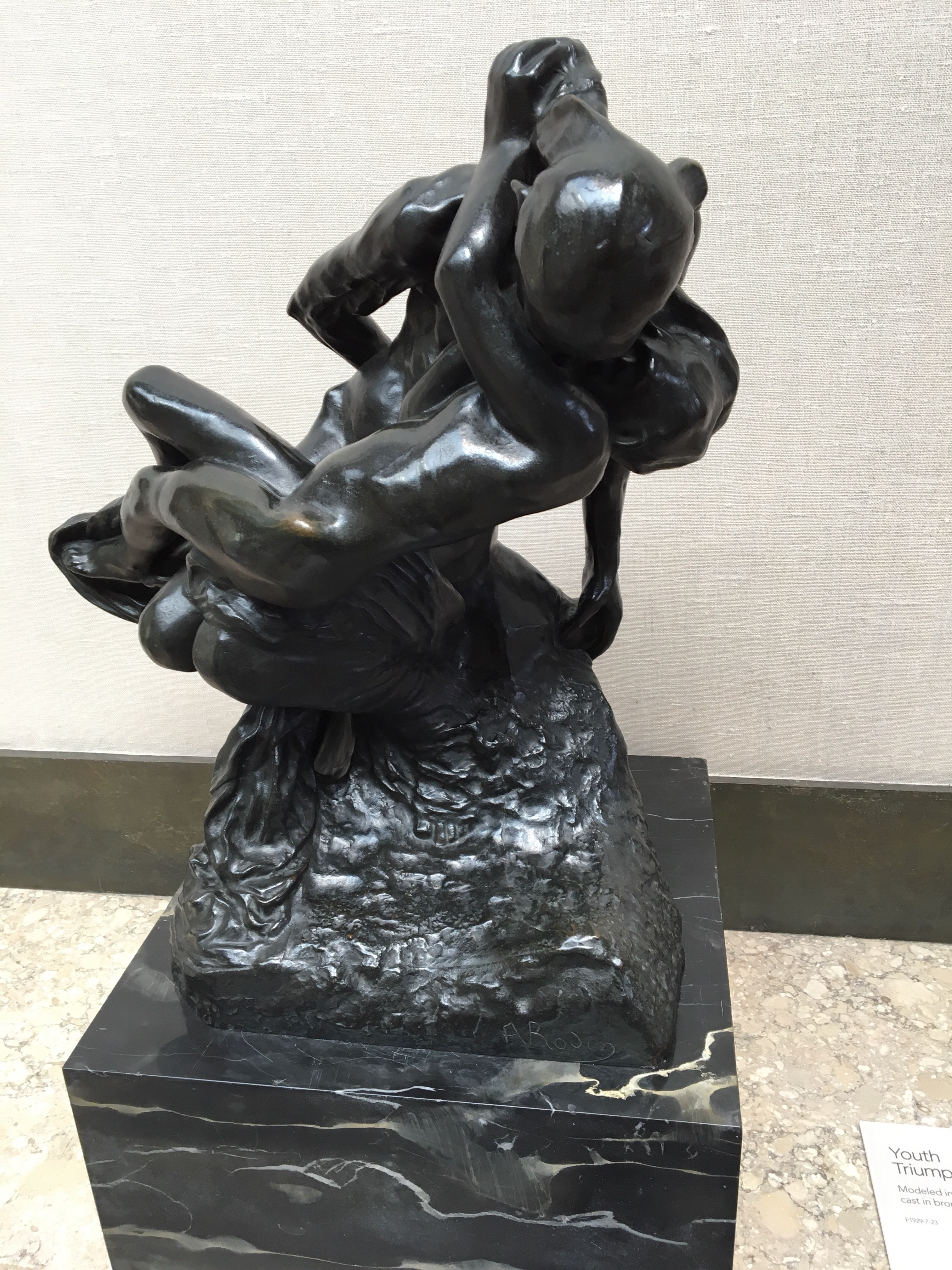
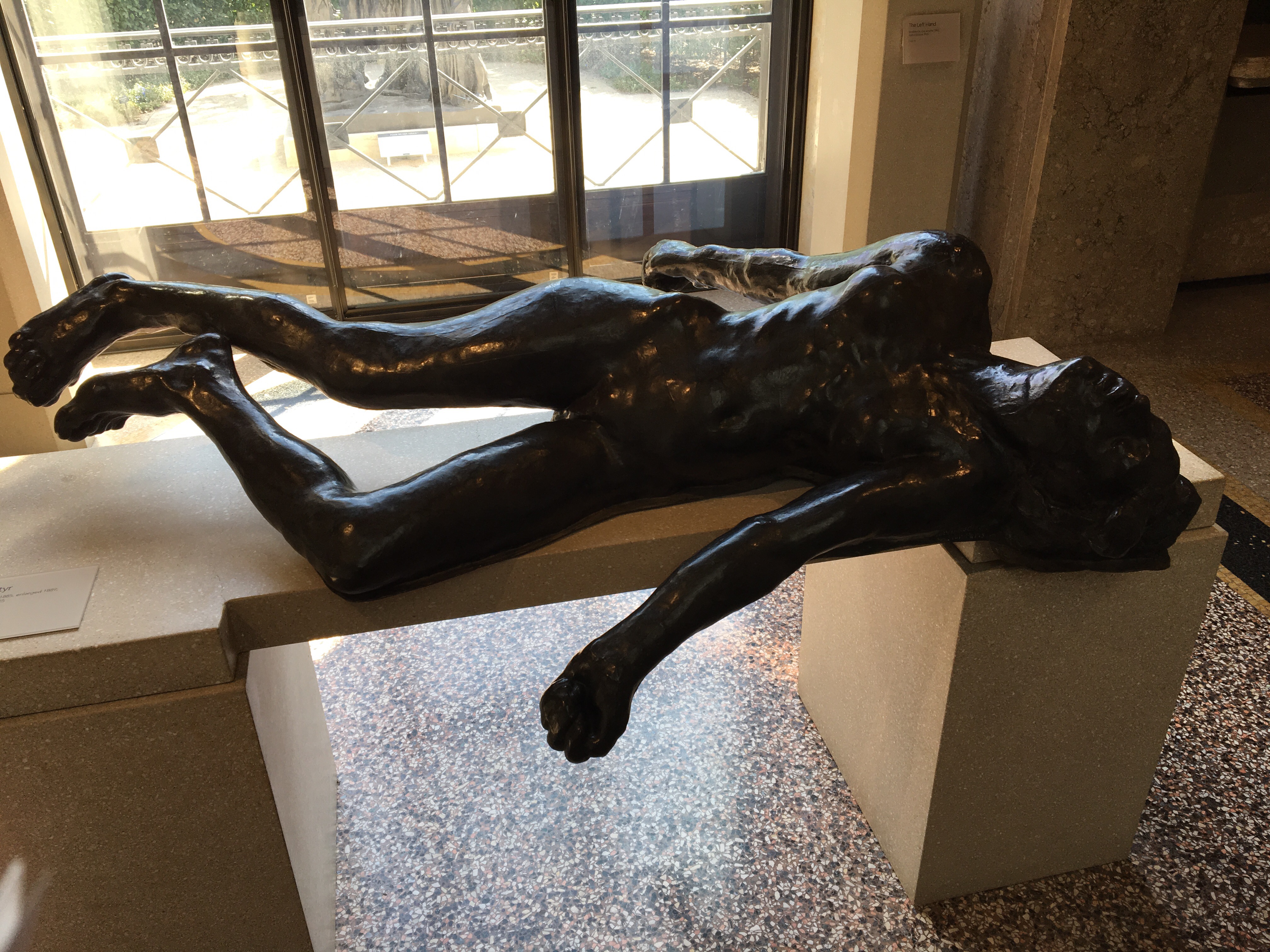
The museum features over 140 pieces of Rodin’s work scattered throughout the building and in the garden area, with samples from every phase of his career. I found myself drawn to Rodin’s hands and faces. I love the way that he depicts emotional extremes, from the anguish of the Burghers of Calais walking towards their death and the gates of hell to the passion captured in I Am Beautiful and the exuberance of Youth Triumphant.
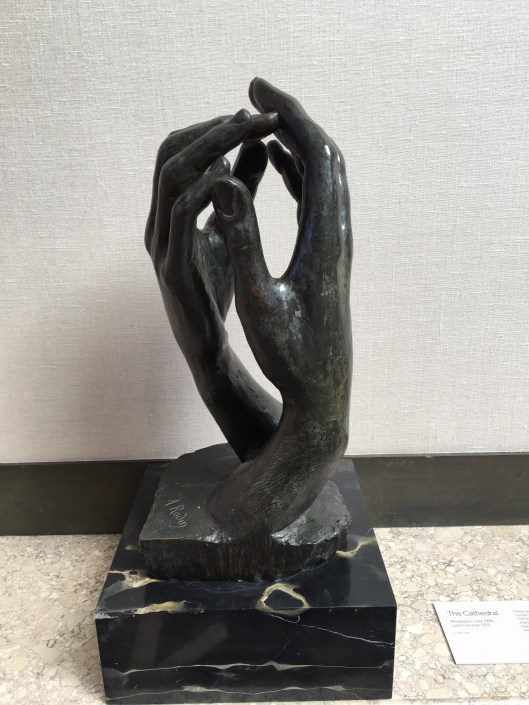
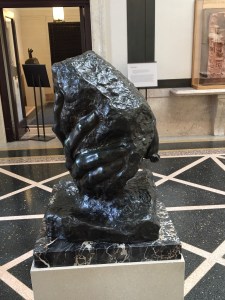
Rodin’s hands are expressive and beautifully rendered. They add layers of meaning to his sculptures. The hands of the burghers – both in the Burghers statues and in the Clenched Hand (an early study for the former) – complement the sense of hopelessness that one gets from Rodin’s faces.
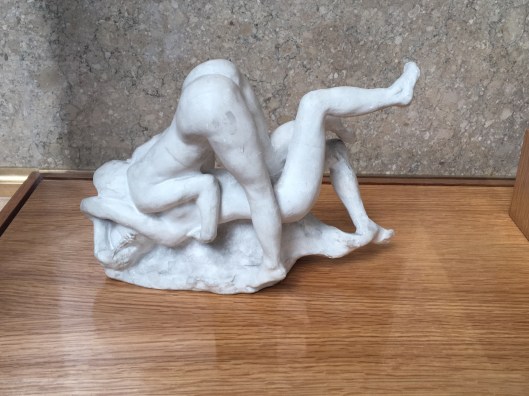
His Cathedral suggests an intimacy between lovers that is a quieter counterpart to the more demonstrative I Am Beautiful or the powerfully passionate the Damned Women.
I was also struck by Rodin’s efforts to grapple with the ineffable through his Hand of God and Gates of Hell sculptures. The Hand of God draws a parallel between human and divine acts of creation, with God as divine sculptor, shaping humanity from a barren rock. The contrast between the hyper-real sculpture of a human hand emerging from a block of marble and the impossible image of the partially formed figures materializing from the rock is striking, almost magical. It’s a beautiful metaphor for the creative process.
The Gates of Hell are a powerful monument to the human experience. It contains figures in agony and ecstatic abandon, along with images suggesting compassion and love (both sexual and maternal).
The Thinker is perched near the top of the gates, surrounded by figures in all manner of embraces (some of which look passionate, others of which almost look torturous).
As with the Hand of God, the title of the piece suggests a straightforward religious interpretation, but the sculpture feels like a tangible representation of a doorway to the human mind, complete with chaotic and contradictory emotions and experiences.
The statues are impressive in photographs and art books but gain a magical quality when viewed in person. The interplay of light and shadow over the curves of the statues spark the imagination and add layers of mystery and meaning.
The hand in the Hand of God felt majestic and awe inspiring upon first view, but after looking at it for a few minutes in the midday light, it almost looked tender.










 between errors