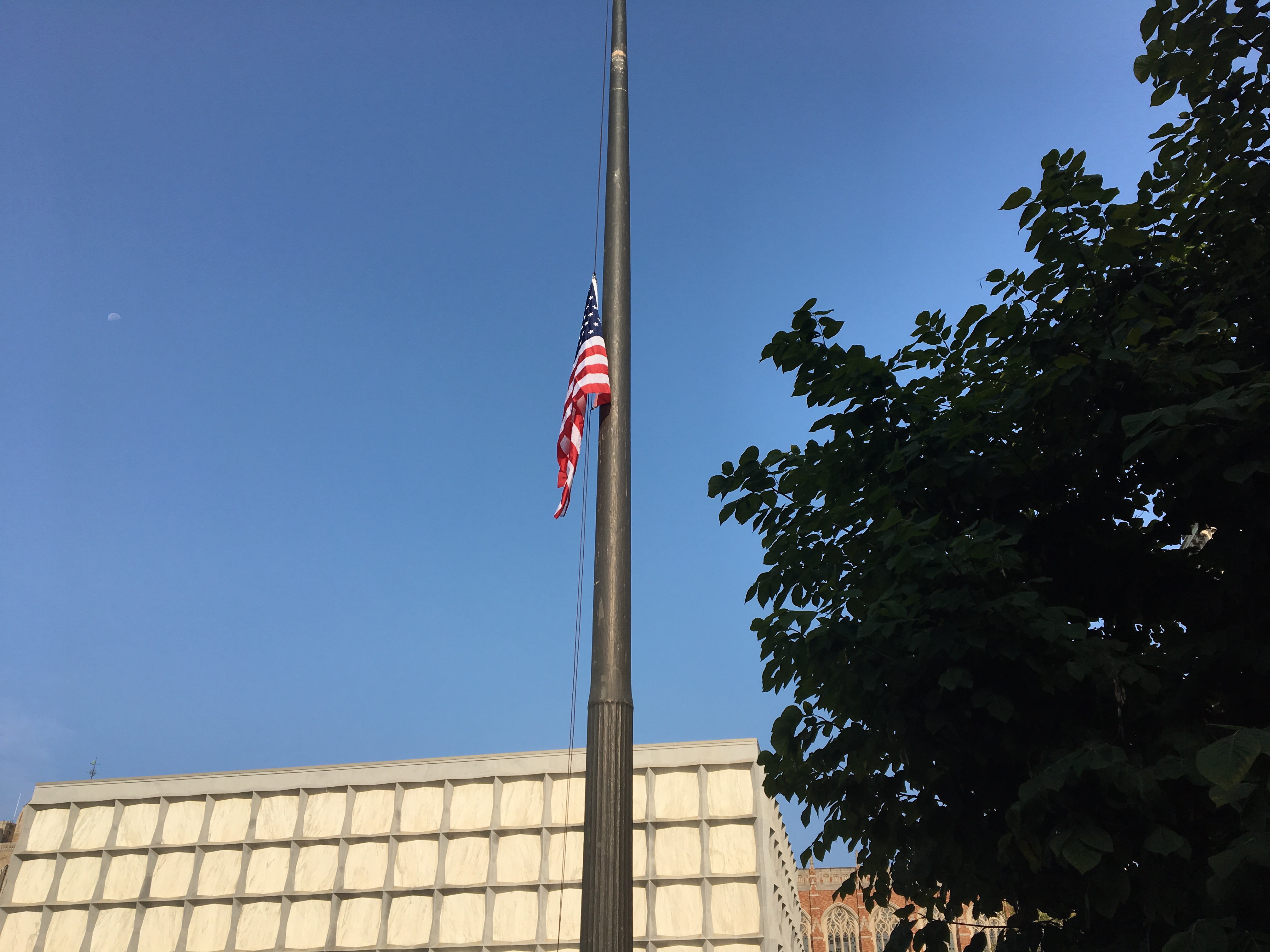
Sixteen years. It still feels like the towers went down a short while ago, but a glance at the crowd at Beinecke Plaza in New Haven for Yale’s 9/11 remembrance ceremony reminded me that for some, sixteen years is a lifetime. Some of the young people who surrounded me were Yale undergraduates who were toddlers when the towers fell. For others, the tragedy may have been their first memory of a public tragedy (mine was the Challenger space shuttle disaster from 1986). I imagine that some of the students grew up thinking of 9/11 as a tragedy that took place in a foreign land. There were also plenty of folk from my generation in the crowd, along with those who remembered wars and tragedies from before my time.
We listened to a man who graduated from Yale College the year after I graduated from SUNY Purchase talk about 9/11 and the sensation of being swallowed whole. He prompted us to reflect on the sixteen years after 9/11, to ask ourselves: “what kind of person have you become?” “what neighbor have you helped?”
I’m tempted to write about how I’ve changed in the last sixteen years, to think about how my life is different than I expected (in good ways and bad), or about how that sense of terror and panic that followed the fall of the towers never went away. I could tie my personal and professional narrative to a commitment to helping people from marginalized groups. It might even be true.
But that’s not what I think about when I reflect on 9/11. I think about the people whose stories came to an abrupt end, those who didn’t have the opportunity to finish crafting their narrative. The people who never experienced all of the amazing and terrifying things that happened over the last sixteen years.
I think about them – all strangers to me – and the sixteen years fall away, and I’m listening to my grandmother tell me on the phone that a plane hit one of the towers of the World Trade Center, and I turn the tv on to the Today show and try to reassure her (“it’s probably just a terrible accident”, “a horrible coincidence”) and watch the second plane hit the tower.
Yale Chaplain Sharon Kugler spoke at the outset of the event, and a phrase she delivered stuck in my mind. “Let us embody peace.” I can try. It feels like the best way of honoring those whose stories came to an end sixteen years ago.
I care about complete artistic statements in pop culture – the album, the film, the run on a comic book series by a single creative team, or the complete television series. When I wax nostalgic about a youth misspent listening to music, I dream of the seemingly endless series of near-perfect hip-hop albums from my high school years.*
I enjoy scenes from films and passages from books, but always felt like their meaning mostly came from their relationship with the larger whole. The scenes and passages that tend to linger over the years are the ones that are informed by (or inform) other scenes in the larger work.
But there are still some moments that I can enjoy as discrete statements of their own. Here are a few from film and television:
Ocean’s Twelve, directed by Steven Soderbergh
Treme, Season 3, Ep. 2, directed by Jim McKay
Mad Men, Season 5, Episode 12, directed by Chris Manley
The Raid: Redemption, directed by Gareth Evans
More later.
*Note: I am not being an old fogey, I grant that every generation of high schoolers has an identical experience with the great albums of their time.
I planned to write these every week, but unexpected complications related to a move, health problems for a loved one, an insane workload and an event I’m planning contributed to the delay. So, here we go…
Sometimes I think that 2015 was the first year when stories in licensed comicsfelt more emotionally complex and creatively ambitious than the ones in stories published by Marvel and DC.
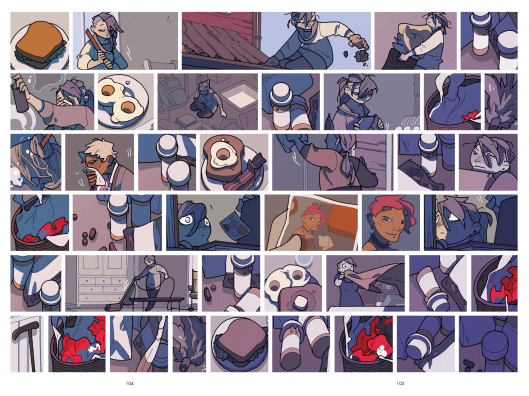
In Heart in a Box, Kelly Thompson and Meredith McClaren tell thestory of a woman who recovers from heartbreak by going on a quest to literally reclaim the missing pieces of her heart. It’s a fabulist premise that the two creators use as a vehicle to tell a pretty grounded story about learning how to reengage with the outside world.
The book is filled with great sequences. In the section above, McClaren compresses six days of chores (Emma agreed to do some for a cantankerous old man in exchange for a piece of her heart) in a dialogue free 41 panel two page spread. She depicts a repetitive sequence of mundane tasks interspersed with suggestions that the old man is not well. Emma cooks, vacuums, sweeps, scrubs floors and cleans gutters. As the reader’s eye follows the sequence of panels, the truth becomes clearer. In the first row of panels, we see a medication bottle, and in the second we see a tissue with a hint of blood. In the third, we see where the tissues come a close up of from. As the story progresses, we see more tissues with more blood. By the time we get to the bottom of the page, the majority of panels are focused on the old man’s illness. The final panel is heartbreaking.
In the hands of other creators, Heart in a Box might have felt manipulative and ostentatiously sentimental. Although many of the characters Emma meets on her quest have experienced (or are experiencing) some great tragedy, McClaren and Thompson don’t rely on them to generate an emotional response. Instead they use them to complicate Emma’s feelings about her own experiences. She learns what it’s like to be a heartbreaker and how to empathize with the difficult parent, even if he’s not her own.
Uncanny Avengers #2, by Daniel Acuna and Rick Remender. I read the first five issues of the second volume of Uncanny Avengers on Marvel Unlimited in a single sitting. I lost interest in the plot and the dialogue pretty quickly (other than a few great scenes between the Vision and the Scarlet Witch).
Remender’s version of the High Evolutionary character is slightly different than the one I’m familiar with from the Bronze (and Modern) Age. The High Evolutionary was typically presented as an unbalanced scientist obsessed with mastering evolution, a slightly less sinister modern version of Wells’ classic Dr. Moreau. He tampered with the genetic structure of animals (creating both an evil evolved red wolf with psychic powers and a benevolent evolved cow who was the foster mother to Scarlet Witch and Quicksilver), evolved himself into a god-like figure, and created a version of the Earth where time passes at an accelerated rate. Creators used him as an antagonist, a deux ex machina and a story catalyst over the decades, but Remender and Acuna were the first (that I’ve read) to explicitly address some of the darker implications of the character. Although some treated the character as a symbol for our fears of science untethered from all ethical constraints, almost all portrayed HE in a sympathetic or ambivalent light. Acuna and Remender highlight the social attitudes that might accompany an obsession with accelerating human evolution, particularly from a character who was originally a British scientist from the early 20th century.He may have been depicted as a proto-transhumanist in the past, but it’s not that hard to imagine him as a twisted eugenicist.
This excerpt is from my favorite scene in the arc, when Acuna gives the reader glimpses of ordinary folk in the humanoid animal society. The body language and expressions of the characters is recognizable and emotionally resonant. I’m drawn to the way Acuna uses hands to convey casual intimacy – the deer holding their child, the tightly clasped hands of a zebra and a leopard, the older rhino who places their hands (protectively, almost pa/maternally) on the shoulders of a younger rhino. His images help the reader develop empathy for the New Men and other human/animal hybrids that are usually in the background of these stories.
Remender’s dialogue strikes a chillingly complementary note. The High Evolutionary’s words are heartless and clinical, but when the reader sees the audience, they feel particularly cruel, hinting at a deeply familiar bigotry.
I’m not alway a fan of applying retcons and other character tweaks to earlier stories, but it’s surprisingly easy to imagine that Remender and Acuna’s version of the High Evolutionary is the same (or at the very least, the true) version of the character who appeared intermittently in comics over the last few decades. Everything reads differently if one spends a little bit of time thinking about the sentient beings who were impacted by the High Evolutionary’s actions. You might find that what was traditionally depicted as a slightly unhealthy interest in human advancement might just be an obsession with perfection, and the Evolutionary’s reckless indifference to human life could easily be viewed as an unwillingness to acknowledge the personhood of sentient beings who look different.
It’s not necessary to view the character from this perspective – the next time we see High Evolutionary, he might be a positive symbol of human curiosity – but it’s interesting to think about the possibilities of a Marvel villain who hides their evil behind a veil of rationality.
Well. That was certainly a long commercial break, but we’re back. For those who may have forgotten (and who could blame you!), I’m Jamaal. Here’s a quick recap.
I’m a co-founder of the Funnybook Babylon podcast and blog (we had things to say about comic books). I also tumbl about things at Infected Worldmind. About two years ago, I realized that I had things to say about the broader world of pop culture, so I started a separate wordpress blog. In the fall of 2014, I moved from the Bronx to New Haven (Connecticut) and my blog was hacked. All of my efforts to repair the blog were unsuccessful, so I decided to start a new blog in November 2014. What happened next?
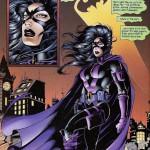
On a fine day last week month in New Haven, I was talking comics on twitter with some friends while waiting for my train to move. The topic was DC Comics’ decision to reintroduce the Huntress (a female vigilante) as a woman with brown skin. If you’ve been following DC’s rebooted New 52 universe, you’ll know that the Huntress was originally re introduced as the daughter of Batman and Catwoman from a parallel universe. This new version of the character is an updated take on Helena Bertinelli, the daughter of a mob boss familiar to both fans of the DC universe that preceded the new 52 and fans of the Arrow television show.
Meghan Hetrick-Murante’s Huntress
Helena Wayne Huntress (George Perez)
Classic Huntress (Thomas Castillo)
Arrow Huntress (Jessica de Gouw)
This decision closely followed DC’s decision to reintroduce Wally West (a character who was Caucasian in earlier incarnations) as an African American. During the conversation, a good friend of mine expressed some concern about DC’s decision to fundamentally change existing characters and mournfully noted that reboots mean that no one ever exists anyway. The comment reminded me that I’ve felt disconnected from DC titles since it’s recent reboot, which led her to suggest that we still feel an emotional connection to the characters even though we all say ‘follow creators not characters’.
On a recent episode of Wait, What?, Graeme and Jeff discussed Jeff’s superhero/adventure comic ennui. (Editor’s Note: This is the best comics podcast since that other one. Become a patron via Patreon.) During the conversation, Graeme suggested that one of the reasons that Jeff found it hard to maintain interest in superhero and adventure comics not published by Marvel and DC was that he didn’t have an emotional/nostalgic connection to the characters in the book. Although Jeff’s lack of interest seemed to be driven by evolving genre preferences and his concern that the superhero/adventure books were part of a broader brand marketing strategy designed to separate readers from their cash, something about Graeme’s suggestion resonated with my own experience. I enjoy a number of the superhero and adventure books published by Image, Dark Horse, Valiant and Dynamite, but I tend to drop (or lose interest in) these titles far more frequently than lesser titles published by Marvel and DC. I love Fred van Lente and Jeff Parker, but frequently have to remind myself to pick up their non-big two superhero books.
Since I became a regular superhero comics reader again in the mid aughts, I’ve been more interested in creators and creative teams than individual characters. I’ve also banged the ‘creators over characters’ drum to everyone I knew who read superhero books. At the same time, I have to admit that I would be more entertained by a great story featuring a Superman analogue if it actually featured Superman. I’m more likely to buy a pretty good X-Men book than a fantastic issue of Harbinger, Valiant’s answer to the X-Men. Does this complicate (or undermine) the idea that creators should be more important than characters?
I don’t think it does. First, I don’t think that my interest in Superman stories necessarily implies any loyalty towards ‘Superman’ as a character or brand. I respect people who love the characters as characters, but sometimes that love looks an awful lot like simple brand loyalty. If someone is into Spider Man because the character’s story and values resonate with something in their lives, that’s great for them. It’s not the equivalent of self-identifying as a Cap’n Crunch super fan. But it’s hard to ignore the fact that the media conglomerate that owns Spider Man views people who identify as Spider-Man qua Spider Man fans as the “fiends they’re accustomed to serving“.
When I say I love Superman, I’m expressing fondness for stories featuring the character that explore the themes we associate with the Superman narrative. I’m interested in how stories by Greg Pak and Aaron Kuder or Geoff Johns and John Romita, Jr. resonate with earlier stories by creative teams as varied as Grant Morrison and Frank Quitely, Mark Waid and Leinil Yu, John Byrne or Elliott Maggin and Curt Swan. I don’t care if “Superman” is married or single. I don’t care if “Wolverine” dies, but I am interested in how a story by Paul Cornell and Ryan Stegman build on a prior story by Jason Aaron and Ron Garney and an even earlier set of stories by Chris Claremont and Frank Miller in a fictional universe with tighter continuity. When I’m faced with a choice between X-Men and Harbinger, I don’t think that I’m simply expressing loyalty to my favorite brand if I choose X-Men.
I value those stories, but also recognize that the people behind them are more valuable.
An Aside: I guess that’s why I was surprised by my general lack of interest in DC’s most recent reboot. I’ve always been able to roll with the punches in the past, but there’s something about this one that leaves me cold, and it’s not just because most of the books aren’t any good. I know that all reboots are driven by a mix of commercial (expand the audience by making the books accessible to new readers) and creative (give storytellers opportunities to tell stories unburdened by decades of continuity) reasons, but the New 52 (which was preceded by two other recent reboots) just felt like more of a pure marketing campaign, the end-result of an ambitious junior executive’s corporate synergy strategy.
When I tell people to value creators more than characters, I’m trying to express a simple idea: people are more important than property, even if the property is entertaining. It’s not supposed to serve as a blanket condemnation of readers who enjoy books featuring their favorite Marvel or DC character or who have some emotional connection to the characters. It’s more of a friendly (and easily misunderstood) reminder that storytellers are more important. A nudge to get readers to think more about creators and question the degree to which we’ve aligned our perspective on the art form with that of media corporations and become shareholders with no equity. But I’m not sure that’s a good enough explanation. What do I really mean when I argue that creators are more important than characters?
We need more explorations of intimacy on television. Sometimes it feels like almost all of the prestige dramas in the so-called second golden age of television – shows like The Sopranos, The Wire, Deadwood, Mad Men, Breaking Bad – were extended meditations on aggressive masculinity and physical and emotional violence that relegated other experiences to the margins.
Baz Luhrmann’s films are often disparaged as celebrations of empty excess, but I’ve always thought he was a genius at using spectacle to inspire empathy for characters living in unfamiliar worlds.
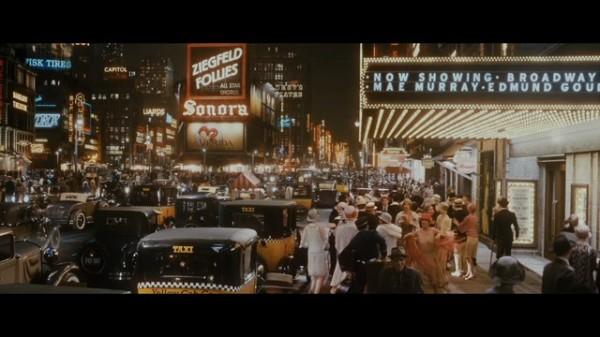
His films are loud, unsubtle and tasteless. They take place in garish, beautifully designed worlds that bear no resemblance to reality and feature theatrical performances and almost comically unsubtle directing. They also do a better job of capturing the emotional truth of the source material than most adaptations of classic material. Luhrmann’s adaptation of the Great Gatsby is not good – a number of the techniques that felt innovative in earlier movies felt like hoary cliches and he was far too reliant on digital special effects – but he still did a better job of giving the audience insight into the fears, beliefs and desires of the characters than previous adaptations of the Fitzgerald original.
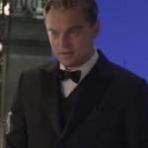
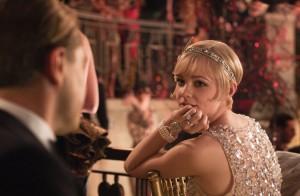
Some of this success can be attributed to the performances. Leonardo DiCaprio’s Gatsby is a perfect blend of Jack Kennedy and Frank Abagnale, and Carey Mulligan turns Daisy Buchanan from an elegant cipher into a tragic reminder of the limited choices upper class women had in the Jazz Age.
Joel Edgerton effectively captures the pitiful, callous cruelty of Tom Buchannan. I was pleasantly surprised by Maguire’s performance. This was the first time I’ve liked him since Wonder Boys. He managed to convey Nick Carraway’s passivity without becoming entirely inert (which was a real problem with Sam Waterston’s depiction in Jack Clayton’s 1974 adaptation).
But Luhrmann also deserves some credit for using music, light, costumes, set design and movement to convey emotion.
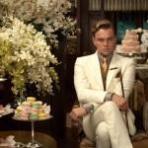
It’s the way that Gatsby’s perfectly tailored suits look like elegant couture at the first party and like a costume when he meets Daisy for a rendezvous at Nick’s house or how Luhrmann uses music, light and sound to evoke the feeling of going too far at your first party and realizing that what appeared wild and anarchic is pretty tame by the light of day.
In some ways, Luhrmann was a perfect choice as a director to adapt Gatsby. The sketchy, archetypal quality to the characters in Fitzgerald’s novel complement Luhrmann’s ongoing effort to use seemingly superficial things – style, music, movement – to suggest deeper truths in his films. Unfortunately, this message is undermined by all of the directorial tics and indulgent tendencies that he’s developed over the years.
In Luhrmann’s earlier movies, the fanciful sets helped create the sense that the viewer was in a heightened fantasy world, but in Gatsby, his computer generated New York was a distraction that robbed meaning from almost every emotionally honest moment, with the notable exception of the last confrontation between Gatsby and Tom Buchannan. It felt like the actors were performing in a Roaring Twenties video game.
There isn’t much difference between Luhrmann’s approach in Gatsby and in Moulin Rouge or Romeo + Juliet. He’s always embraced artifice and smothered performances with bombast and spectacle.
So why does Gatsby feel so unsatisfying? I think the answer lies in the difference between practical effects used in the earlier films and computer generated effects in Gatsby. There was a charm to the ornate handcrafted sets and practical effects that were lacking in Gatsby. It helped root the spectacle in a recognizable world.
Although the computer generated effects in Gatsby were an amazing technical achievement, they were also a bit mundane. Luhrmann’s impossibly perfect fantasy version of New York is the one that exists in the mind’s eye of anyone vaguely familiar with the Jazz Age. It lacks a personal touch, the idiosyncratic flair that we’ve come to associate with Baz Luhrmann movies. I also can’t help but feel like a story that’s essentially a critique of fantasy and deluded love is undermined by an idealized Jazz Age New York.
All of the familiar elements of Baz Luhrmann films are here – the migraine inducing quick cuts, the ornate sets, the inappropriate music choices – but where they once felt provocative and daring in earlier films, in Gatsby they were dull and predictable. Even the more interesting Luhrmann touches were underwhelming. The dance sequences were well orchestrated, but lacked the thrill of Moulin Rouge.
The hip-hop tinged modern soundtrack was a cute idea, but the execution was lacking – every time I heard Jay-Z, I was pulled right out of the narrative.
Is hip-hop in the 21st century the equivalent of jazz in the 1920’s? I think one can argue that it was a visceral and culturally exciting music in the eighties and nineties, but I’m not sure that it plays that role in our culture anymore. Jay-Z is an institution. He’s the status quo. Jay might’ve been a daring choice for a 1998 version of this film, but this is 2013. Jay’s the guy who represents ball players and used to own a piece of the Not-New Jersey Nets. Am I the only one who suspects that a real teenager would scoff at the idea that hip-hop is the cutting edge, hip young music of the future?
It’s a shame that Gatsby doesn’t work, because it’s clear that Luhrmann gets the class conflict at the core of the original novel. He never lets the viewer forget about the ocean of privilege between Nick and Gatsby or between Gatsby and the Buchanans. Luhrmann evokes the racial tension hinted at in the novel by including African American faces at key moments in the narrative. When Tom rambles about the primacy of western civilization, or parties with his mistress in a Manhattan hotel room, or when Gatsby is driving Nick to the city and spinning a desperate web of lies, Luhrmann makes sure that we see a black face (or several) at some point in the scene. He reminds me of the untold side of most narratives set in this era, of the people who were only heard when they were singing or playing music on a stage. The only problem is that Luhrmann shows too much of the joy and none of the pain. There was something a little bit too joyous and celebratory about the tenants at the tenement across the street from Tom’s illicit meeting place or the passengers in the car that passes Nick and Gatsby on the bridge has too many bottles of Moët. The latter scene is directly from the book, where Fitzgerald writes:
“As we crossed Blackwell’s Island, a limousine passed us, driven by a white chauffeur, in which sat three modish Negroes, two bucks and a girl. I laughed aloud as the yolks of their eyeballs rolled toward us in haughty rivalry.
‘Anything can happen now that we’ve slid over this bridge,’ I thought; ‘anything at all…Even Gatsby could happen, without any particular wonder.”
Luhrmann does a nice job with the visuals. Three people of color, two male, one female, all of whom are stylishly dressed and chaffeured by a white man (imagine the scandal!). He misses Nick’s ambivalence about class mobility (which is made more vivid when it intersects with race), the familiar discomfort that established classes have with the consumption patterns of the nouveau riche (or the nouveau middle class). Without the mocking laughter and class conflict, the moment becomes ahistorical and meaningless.
I didn’t think that Luhrmann would capture the nuance or lyricism of Fitzgerald’s novel, but I assumed that he would find a way to use his uniquely bombastic brand of melodrama to evoke the central themes of the book. Luhrmann fulfilled those expectations, but was undermined by his failure to evolve as a filmmaker. The interesting moments were drowned out by the stale ones. But I still have a soft spot for Luhrmann films. The bombast, spectacle and visual candy with a touch of camp. I hope that he finds a way to combine that zaniness with more forward thinking ideas in his future projects.
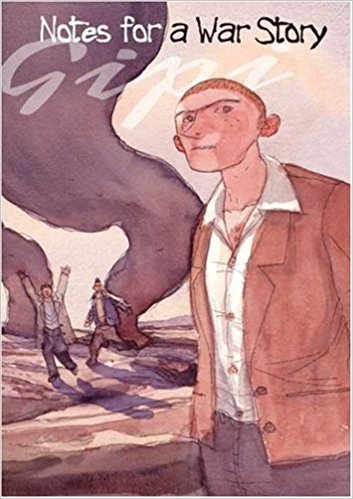
Notes of a War Story, produced by Gipi, and translated by Spectrum. Notes is published by First Second Publishing, an imprint of Roaring Brook Press, and was originally published as Appunti per una storia di guerra in 2004 by Coconino Press.
Gipi doesn’t tell the kinds of stories that I’m used to reading in comic books. I grew up on Marvel and DC comics, so I tend to enjoy comics that convey meaning through plot. My earliest comics are filled with dialogue and exposition that clearly explains the plot to the reader. Comics that always tell you exactly what they mean. Although many of today’s ‘mainstream’ books are more sophisticated, most are complicated (or convoluted), not complex. Gipi takes a different approach. I first became familiar with Gipi when I read Garage Band for the tenth episode of the Funnybook Babylon podcast. In Garage Band, Gipi uses ordinary moments to provide insight into the interior lives of the characters and establish a mood that made the plot feel unimportant.
The war arrived in our village on the 18th of January. Obviously there were other wars going on, but they didn’t have anything to do with us. There were wars for blacks. Wars for Arabs. Wars for Slavs. Our war started on the 18th of January, and in a few days, everything had changed.
Notes of a War Story is ostensibly the story of a group of friends coming of age in the midst of an unnamed European war taking place in an anonymous Balkan nation. The lack of specificity, in time or place, gives the book a allegorical, dream-like quality. The group of three boys embody some familiar archetypes: the sycophant (Christian), the overly aggressive proto-criminal (Stefano, the “Little Killer”), and the bourgeoisie wayward one (Giuliano), who is our protagonist. The first two are representative of the lower class, both poor, one subjected to emotional (and probably physical) abuse. The third stands for the middle class. He’s the one who grows up with a lawn and a bed. The crazy one is the leader (aren’t they always?), which sets in motion a series of events that culminate in a set of life changing choices for all three.
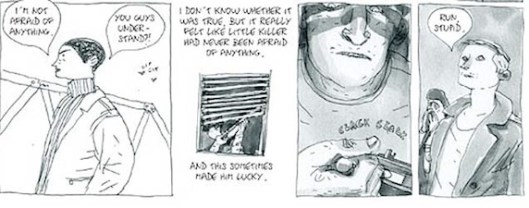
I didn’t read the dialogue in this book until my second read. I was too busy falling in love with the images and Gipi’s visual storytelling. Gipi’s work is deceptively simple, using relatively few strokes to create distinct and expressive characters.
Notes tells several stories simultaneously. The narrative closest to the surface is about young men getting involved in a situation that they can’t handle. But this is also a tale about the impact of war on the lives of those who are simply trying to survive in its midst. Gipi shows us a society divided between predators and prey. The people shown in Notes are either the gangs preying upon the cities, the anonymous hustlers thriving on the collapse of the social order, or those who are conspicuous by their absence. After completing Notes, it also seems that there is a narrative lurking in the background that Gipi refuses to tell, opting to only express it through oblique references. One imagines that for an artist less concerned with the fate of wasted youth, the focus of Notes could easily have been Felix, the minor gang boss that acts as a mentor to the three youths. But that is one of Gipi’s strengths. He refuses to tell every aspect of the story, to fill in all of the blanks for the reader.
The war changes the characters, and provides an opportunity for transformation. For Giuliano, the war provides an excuse for him to abandon his life. His village is severely damaged by the war, and now he is living in a world that he had only experienced through computer games. The question he faces is whether he has the skills to survive in this new world. However, for almost everyone else, the war reveals their true selves. Little Killer starts off as a kid who is trouble, the kind who starts fights, and gets suspended from school.
One envisions Stefano as the type who is both charismatic and psychotic enough to be a gang leader. But the story reveals Stefano’s hidden nature, his need for guidance, as he becomes, in the end, a willing flunky for Felix. Although Stefano and Giuliano view the other as a polar opposite, Christian is really the antithesis of both. He has neither the options of Giuliano, nor the will of Stefano, and in many ways, his story is the most tragic in this tale. He represents the masses who see conflict as an opportunity to rise above their station, without fully understanding the sacrifices that are necessary to do so. He is the true innocent of this tale, lacking the viciousness of Stefano or the self-awareness of Giuliano.
In the end, Notes is a morality play that centers around three choices that need to be made in the midst of a crumbling society. Should you bind yourself to the old society or ally yourself with the new? Will you ally yourself with the predators or the prey? Should you remain passive or take an active role in the conflict? The first two questions offer the possibility, however slim, that you can change your mind, or at the very least, pretend that no choice was made. Once you are in the front lines of a conflict, there is no turning back.
Giuliano seems to be the only character that sees this. Haunted by nightmares of his friends, who mock him for his status, and by memories of a life unmarked by tragedy, he knows that the choices that he makes limit his future options. For his friends, those limited options are the only ones that they see. In the afterword, Alexis Siegel notes the significance of the dreams in which Stefano and Christian are headless and interchangeable. Siegel links the dreams to Giuliano’s refusal to “stop thinking for himself” as well as his potential for introspection, something that the other two lack. I think it signifies their absence, that on some level, they embraced their fate the moment they left San Donato. Note that in the dream sequence, nothing was left of the two but their clothes and indistinct hands. In some ways, they were already ghosts to him.
Notes for a War Story is currently available in both comic book stores and book stores, and all images are copyright by Gipi.







 between errors